
Legionella in Data Centres: Chlorine Dioxide Treatment
As Australia’s data centre industry expands to support artificial intelligence, cloud computing and digital infrastructure, demand for dependable cooling systems continues to grow. Alongside energy efficiency and water use, microbiological safety deserves attention—especially in facilities using evaporative cooling towers.
Cooling systems that circulate warm water and generate aerosols can create conditions in which Legionella bacteria multiply if water quality is not adequately managed. Chlorine dioxide (ClO₂) is one treatment option that can support an effective, monitored cooling-water management program.
Why Legionella is a concern for data centres
Data centres produce substantial heat through servers and electrical infrastructure. Depending on their design, cooling arrangements may include evaporative cooling towers, open recirculating condenser loops, adiabatic equipment, storage tanks and heat exchangers.
Legionella can proliferate in water systems with favourable temperatures (commonly around 20–45°C), stagnant areas, nutrients and biofilm. When contaminated water is aerosolised, inhalation of droplets can cause Legionnaires’ disease, a serious form of pneumonia.
Important distinction: Not all data centres have the same risk. Fully closed-loop and dry cooling arrangements generally present different Legionella exposure pathways from open, aerosol-generating cooling towers. A site-specific assessment is essential.
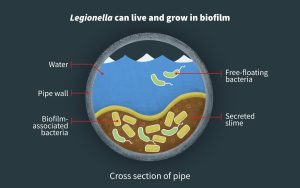
Biofilm: a persistent challenge
Biofilm is a protective layer of microorganisms and organic material that can form on wetted surfaces within pipes, cooling towers, tanks and heat exchangers. It can harbour microorganisms, contribute to fouling and make disinfection more challenging.
- Biofilm can shield microorganisms from disinfectant contact.
- Biological fouling may reduce heat-transfer efficiency.
- Accumulated deposits can increase cleaning and maintenance requirements.
- Microorganisms may regrow if treatment and cleaning are insufficient.
Effective Legionella prevention therefore requires more than adding a biocide: it calls for suitable system design, cleaning, water chemistry control, monitoring and verification.
Why consider chlorine dioxide?
Chlorine dioxide is an oxidising biocide used in industrial water treatment. When properly generated, dosed and monitored, it can help control Legionella and other microorganisms in suitable cooling-water applications.
1. Legionella control
Chlorine dioxide can inactivate Legionella under appropriate concentration and contact-time conditions. Performance depends on temperature, water chemistry, organic loading, flow and the characteristics of the system.
2. Biofilm management
Chlorine dioxide can help manage biofilm-associated microorganisms and biological fouling. Established deposits may still require physical cleaning and complementary treatment measures.
3. Performance across a broad pH range
Its disinfection action is generally less sensitive to pH than free chlorine, which may be advantageous in certain cooling-water operating conditions.
4. Automated dosing
On-site generation and controlled injection can be integrated with instrumentation, alarms and existing water treatment infrastructure to maintain specified treatment conditions.
5. Support for continuous operations
A well-engineered treatment program can support microbiological control while cooling equipment remains in operation, subject to system-specific engineering, compatibility and safety assessments.
How chlorine dioxide treatment works
1. Assess the cooling-water system
Review microbiological results, water chemistry, hydraulics, operating temperatures and existing treatment arrangements.
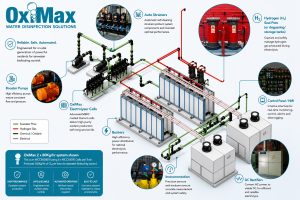
2. Generate chlorine dioxide on-site
Use a purpose-designed generator with appropriate chemical storage, containment and safety controls.
3. Dose into the circulation system
Introduce chlorine dioxide at engineered injection points to achieve the specified treatment conditions.
4. Monitor and control
Measure disinfectant residuals and other relevant parameters; use automated controls and alarms where appropriate.
5. Verify performance
Combine laboratory microbiological testing with inspections, cleaning, records and ongoing maintenance.
Chlorine dioxide vs free chlorine
| Characteristic | Chlorine dioxide | Free chlorine |
|---|---|---|
| Legionella control | Effective with validated dosing | Effective with validated dosing |
| pH sensitivity | Relatively low | Higher |
| Biofilm management | Useful oxidising biocide | Useful; performance varies |
| Organic matter | Selective oxidation, but still subject to demand | Reacts with many organic compounds |
| Automated dosing | Available | Available |
| By-product considerations | Chlorite and chlorate | Potential chlorinated by-products |
Neither disinfectant is universally preferable. Selection should account for microbial risk, corrosion and material compatibility, chemical handling, by-products, discharge requirements and the full water treatment program.
Why prevention matters to operators
Inadequate cooling-water management can lead to health risks, investigations, corrective maintenance, unplanned intervention and reputational harm. A robust program supports workplace and community safety, operational continuity, asset management and documented compliance.
Australian standards and obligations
Australian cooling-water operators should consider applicable state and territory laws and the AS/NZS 3666 series for microbial control in air-handling and water systems. Requirements differ by jurisdiction and may include risk management plans, inspections, laboratory testing, reporting and corrective action.
Chlorine dioxide is one component of risk management—not a replacement for cleaning, maintenance, appropriate sampling, validated treatment controls or legally required response procedures. Specialist assessment is necessary before installation or changing a treatment regime.
Water Engineers Australia solutions
Water Engineers Australia works with industrial water treatment technologies, including eChem chlorine dioxide generation. For data centres with suitable evaporative cooling infrastructure, on-site chlorine dioxide generation can be evaluated as part of an integrated microbiological control strategy.
Whether a facility is being designed or an existing cooling-water system is under review, early assessment of Legionella risk and treatment options can support safer, more reliable long-term operation.
Popular Categories
Latest Post
August 10, 2026
July 21, 2026
Signup our newsletter to get update information, news, insight or promotions.